Many people began collecting such coins, hoping that the John Adams Dollar coin value would increase significantly over the next few decades.
Perhaps this is the first time any of you have ever heard of such a series of coins, and then, of course, you can conclude that these coins are probably worthless, since no one has heard of them.
But in fact, you can't even imagine what is happening at some auctions where they are fighting for tokens of this series.
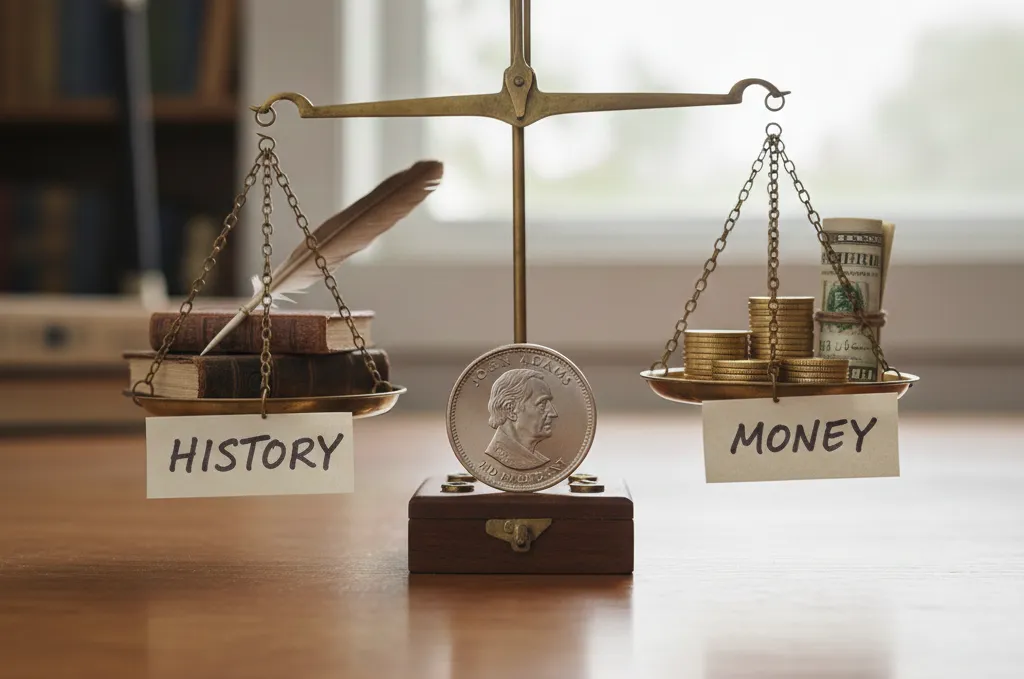
The Second President within the Numismatic Context
John Adams served as president from 1797 to 1801, playing a very important role in the early history of the country. The decision to place his image on a modern coin has helped many citizens remember his contribution to the American government.
When designing the coin, it took the collaboration of many artists to create a realistic depiction of the historical figure.
The John Adams coin was unveiled to the general public in May 2007 and attracted a lot of attention from banks and retail stores.
Production Volumes and Minting Statistics
The minting process involved large machines that pressed the design into metal circles at a very high speed.
Statistics show that the Philadelphia Mint produced more than 112 million coins for general circulation.
The Denver Mint also contributed a large number, creating over 112 million additional units for the public.
Having a total of more than 224 million coins makes the John Adams dollar a very common item in the modern economy.
Rare coins usually have low production numbers, which makes it difficult for common coins to become expensive.
The high volume of production suggests that most coins found in pockets are only worth their face value.
Later, the government realized that people preferred paper bills, so they stopped making so many coins. This makes the early coins, like the John Adams dollar, less rare than the later ones — you can easily check it with the coin value checker app.
Mint Location | Mint Mark | Production Quantity | Collector Status |
Philadelphia | P | 112,420,000 | Very Common |
Denver | D | 112,140,000 | Very Common |
San Francisco | S | 3,965,989 | Proof Only |
Condition and Grading Standards
The condition of a coin is the most important factor when determining its total financial value.
Professional grading services use a scale from 1 to 70 to describe how well a coin has been preserved.
Most John Adams coins found in change are considered "circulated", meaning they have scratches and signs of wear.
A coin in perfect condition, often called "uncirculated", looks exactly like it did when it left the minting machine.
Collectors pay higher prices for coins that have a high grade, such as MS-65 or MS-67.
A common coin with many scratches usually stays at the value of one dollar, regardless of its age.
Cleaning a coin with chemicals or clothes can damage the surface, reducing its value for serious buyers.
Minting Errors and Their Impact
Some coins contain mistakes that happened during the manufacturing process, making them very interesting to specialists.
The most famous error for the John Adams dollar involves the edge lettering, which is sometimes missing completely.
The edge of the coin should have the year, the mint mark, and the phrase "E Pluribus Unum" engraved into it.
Coins without this lettering are often called "Godless Dollars" because the motto "In God We Trust" was also on the edge at that time. Finding a coin with missing edge lettering can increase the value from one dollar to fifty or even one hundred dollars.
Another error occurs when the edge lettering is pressed twice, creating a doubled effect that is easy to see with a lens.
Errors are rare because the Mint has many inspectors who check the quality with the coin identifier app before they leave the building.
Different Types of John Adams Dollar
There are several versions of this coin, and knowing the difference helps in understanding their worth.
Circulated Coins: These are the coins found in everyday life, used for buying food or paying for services.
Uncirculated Rolls: Banks sometimes have original paper rolls containing twenty-five shiny new coins.
Proof Coins: The San Francisco Mint makes special coins with a mirror-like finish for collectors.
Satin Finish Coins: Some coins were included in official sets and have a smooth, non-shiny surface.
Error Coins: These are the items with missing or doubled edge lettering as described previously.
Proof coins are usually more valuable than regular coins because they were never meant to be spent in stores.
A proof coin from 2007 might cost five to ten dollars, depending on the current demand in the market.
Long-Term Investment Potential
Investing in modern coins requires patience and a good understanding of how the market operates.
The price of a coin depends on how many people want to buy it at a specific moment in time.
Because there are so many John Adams dollars, the price has stayed very low for many years.
Most financial experts agree that these coins will not make a person rich in the near future.
The value might increase if the metal used to make the coin becomes much more expensive.
However, these coins are mostly made of copper and manganese, which are not as precious as gold or silver.
Collecting these coins is often a hobby for people who enjoy history rather than a way to earn a lot of money.
Final Thoughts
Starting a collection can be an interesting way to learn about the different leaders of
Focusing on coins with errors or those in perfect condition is the best strategy for a serious collector.
Most people enjoy the design of the coin and the educational value it provides to younger generations.
Even if the price does not go up, having a complete set of coins is a satisfying achievement for many people.
The John Adams dollar remains a stable part of the American currency system, even if it is not widely used.
Its value is mostly found in its history and the story of the man who helped build the nation.